Is Vietnamese Food Halal? A Guide for Muslim Travelers
Vietnamese food is not automatically Halal, and not automatically off-limits either. It depends on where the meat comes from, what goes into the broth and sauces, and how the kitchen prepares it. Here is what to check with pho, banh mi and other favourites.
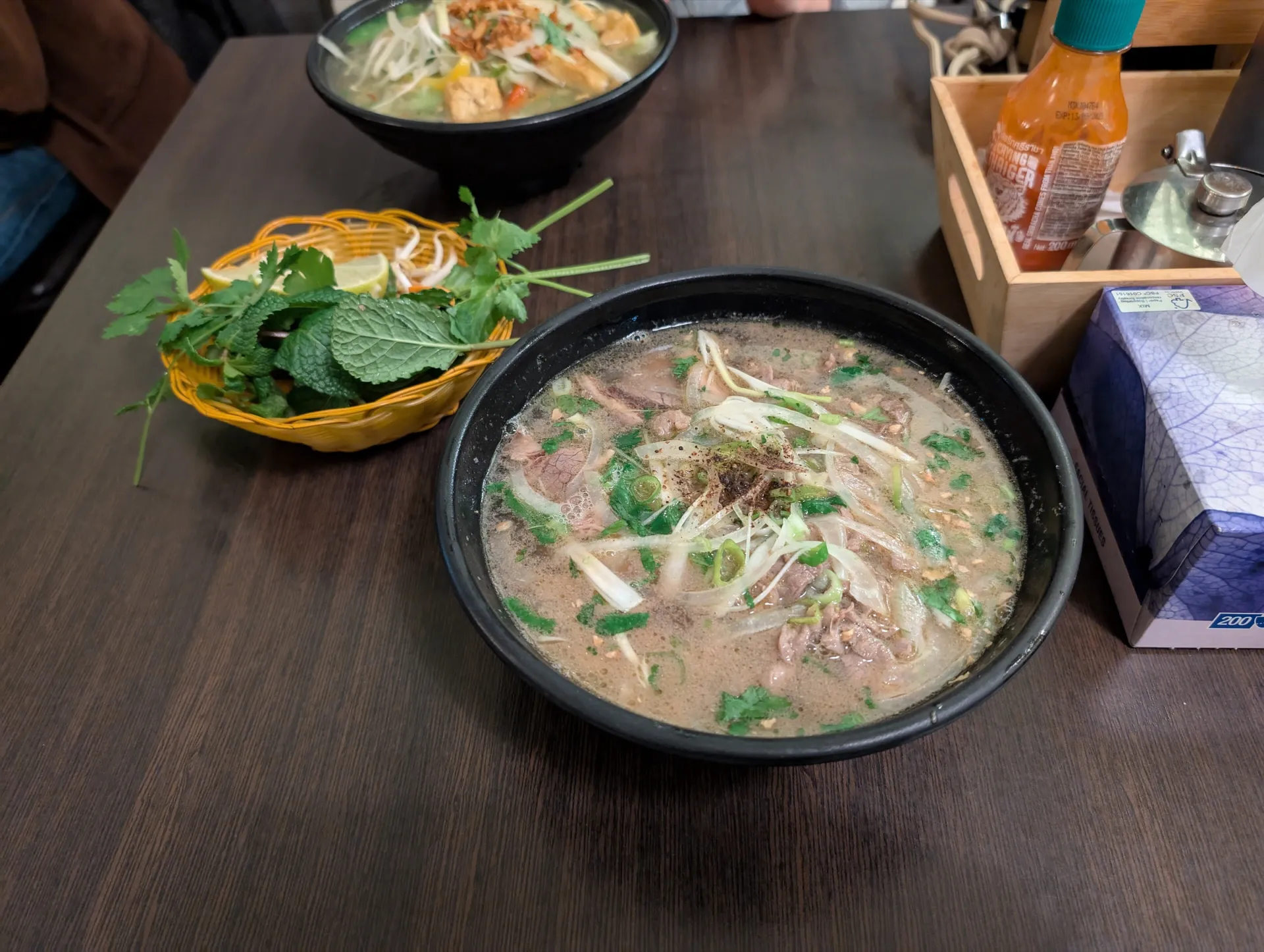 Photo: Andy Li, CC0, via Wikimedia Commons
Explore this story
Vietnam is celebrated for its fragrant noodle soups, fresh herbs, vibrant street food and regional seafood. For Muslim travelers, enjoying these culinary traditions often begins with a practical question: Is Vietnamese food Halal?
The short answer is not necessarily, but many Vietnamese dishes can be prepared Halal.
Pork, pork-based stocks and pâté are common in Vietnamese cooking. Beef and chicken dishes are also widely available, but the type of meat alone does not establish whether a meal is Halal. Broths, marinades, sauces, cooking fats and kitchen practices all matter.
A bowl of phở bò (beef noodle soup), for example, may contain no pork yet still use beef that has not been Halal-certified. A bánh mì gà (chicken baguette) may contain pork-liver pâté beneath the chicken filling.
This guide explains how to enjoy Vietnamese cuisine with greater confidence, from phở and bánh mì to spring rolls, rice dishes and seafood. It also offers practical advice on finding Halal food in Vietnam and arranging meals during an overnight cruise in Ha Long Bay.
Which Vietnamese Foods Are Halal?
No traditional Vietnamese dish should be assumed to be Halal solely because of its name or main ingredient. Recipes vary between regions, restaurants and individual cooks.
The following table is a starting point for deciding what to ask.
Vietnamese dish | Halal by default? | What to check |
|---|---|---|
Phở bò / phở gà – Beef or chicken noodle soup | Not necessarily | Meat sourcing, bones used in the broth, seasonings and shared equipment |
Bánh mì – Vietnamese filled baguette | Not necessarily | Pork fillings, pâté, sauces, spreads and preparation |
Gỏi cuốn – Fresh spring rolls | Not necessarily | Pork or other fillings, dipping sauce and preparation |
Nem rán / chả giò – Fried spring rolls | Not necessarily | Meat filling, cooking oil and dipping sauce |
Cơm gà – Chicken rice | Not necessarily | Chicken sourcing, broth, cooking fat and sauces |
Cơm tấm – Broken rice | Often served with pork | Grilled meat, shredded pork skin, pâté or other accompaniments |
Bún chả – Grilled pork with noodles | Traditionally contains pork | Halal alternatives require different ingredients and preparation |
Bún bò Huế – Spicy noodle soup | Not necessarily | Beef and pork ingredients, bones, sausage and broth |
Chả cá – Vietnamese fish dish | Depends on preparation | Fish, marinades, cooking fats and accompaniments |
Vegetarian dishes / món chay | Not automatically | Broths, sauces, alcohol-derived ingredients and shared utensils |
Fish and seafood | Depends on preparation and individual standards | Species, marinades, sauces, cooking methods and shared equipment |
A useful distinction: Pork-free, vegetarian and Halal-certified are not interchangeable descriptions.
A restaurant may prepare a meal without pork while using meat from an unverified supplier or equipment shared with non-Halal dishes. Travelers who require formal Halal assurance should verify the certification and its scope.
Is Pho Halal?
Pho can be Halal, but ordinary beef or chicken pho should not be assumed to be Halal. The meat, broth, seasonings and preparation must all meet the requirements followed by the diner.
Pho is one of Vietnam's most recognisable dishes. Flat rice noodles are served in a fragrant broth, commonly prepared with beef (phở bò) or chicken (phở gà), and accompanied by herbs, lime and chilli.
Its apparently simple ingredients can conceal several details worth checking.
1. Is the beef or chicken Halal?
The fact that a bowl contains beef rather than pork does not automatically make it Halal.
For travelers who require Halal-slaughtered meat, the restaurant must be able to establish that its beef or chicken comes from an acceptable source.
When in doubt, ask whether the supplier or restaurant holds relevant Halal certification.
2. What is the pho broth made from?
Traditional pho broth is often simmered from bones, aromatics and spices over several hours.
Beef pho generally uses beef-based broth, while chicken pho commonly uses chicken-based broth. However, recipes vary.
Ask whether the broth contains:
Meat or bones from a source that has not been verified as Halal.
Pork bones or pork-based stock.
Alcohol-containing ingredients or other seasonings that conflict with your requirements.
A bowl cannot be assessed by its toppings alone. The broth is just as important.
3. How is the pho prepared?
Restaurants may use common cutting boards, utensils, stockpots or serving equipment for different dishes.
If separation from non-Halal ingredients is important to you, ask how the kitchen manages preparation and cross-contact.
Where can you find Halal pho in Vietnam?
Dedicated Halal restaurants and restaurants serving Muslim travelers may offer pho prepared with verified ingredients.
Vietnam's official tourism website also features Halal Vietnamese dining options, demonstrating that traditional dishes can be adapted without losing their culinary identity.
However, restaurant practices and certification status can change. Check the restaurant's current information before visiting.
The takeaway: Phở bò and phở gà can be suitable Halal dishes when their ingredients and preparation meet the relevant requirements. The name of the dish is not sufficient evidence.
Is Banh Mi Halal?
Traditional bánh mì is not automatically Halal, and many popular versions contain pork. Halal bánh mì can be prepared, but travelers should check the filling, pâté, spreads, sauces and preparation method.
A Vietnamese bánh mì combines a crisp baguette with savoury fillings, fresh vegetables, herbs and condiments.
Although bánh mì is often described simply as a Vietnamese sandwich, what goes inside can differ considerably.
Pork fillings
Common fillings include:
Thịt nguội – Cold cuts, often pork-based.
Chả lụa – Vietnamese pork sausage.
Thịt nướng – Grilled meat, frequently pork.
Heo quay – Roast pork.
Chà bông – Meat floss, often made from pork.
Do not assume that a filling described only as "meat" or "sausage" is suitable.
The hidden ingredient: pâté
Pâté is one of the most important ingredients to check.
Many bánh mì vendors spread pâté inside the baguette before adding the main filling. Vietnamese pâté is commonly prepared with pork liver and may include other animal-derived ingredients.
Even an egg or chicken bánh mì may contain pâté unless the customer asks for it to be omitted.
Mayonnaise, butter and sauces
These ingredients are not automatically non-Halal, but their recipes can vary.
Check unfamiliar processed spreads and sauces, particularly where animal-derived ingredients or alcohol-containing seasonings may be involved.
Can you order a Halal bánh mì?
Yes, a Halal version is possible.
Restaurants may use appropriately sourced beef or chicken, vegetables, eggs and suitable condiments, prepared under acceptable kitchen conditions.
For travelers requiring Halal certification, the most reliable approach is to choose an establishment that can substantiate its ingredients and preparation.
Practical tip: Asking for "no pork" is useful, but it is not a substitute for asking whether the complete sandwich is prepared to Halal requirements.
Are Vietnamese Spring Rolls Halal?
Spring rolls are among Vietnam's most familiar dishes, but the ingredients differ substantially between fresh and fried varieties.
Fresh spring rolls – Gỏi cuốn
Fresh spring rolls are commonly made with rice paper, vermicelli noodles, herbs and fillings such as prawns and pork.
Vegetable-only, tofu and seafood versions also exist.
Check the filling and dipping sauce. Peanut-based sauces and other accompaniments may vary between restaurants.
Fried spring rolls – Nem rán / Chả giò
Traditional fried spring rolls frequently contain minced pork, although seafood and vegetable variations are available.
Ask about the filling, cooking oil and whether the fryer is shared with non-Halal foods.
The appearance of a spring roll does not reveal its ingredients, so requesting a clear description is worthwhile.
Other Vietnamese Dishes Muslim Travelers Should Know
Vietnamese cuisine is remarkably regional. Dishes that share similar names can have different ingredients depending on where they are prepared.
Rice dishes
Rice is a staple across Vietnam, but the accompanying ingredients deserve attention.
Cơm tấm, or broken rice, is commonly served with grilled pork, shredded pork skin and egg-based accompaniments.
Cơm gà, chicken rice, may be a possible alternative when the chicken, broth and sauces meet Halal requirements.
Rice served with fish, tofu or vegetables can also be suitable, depending on ingredients and cooking practices.
Noodle dishes
Not every Vietnamese noodle soup is made in the same way.
Bún chả is traditionally centred on grilled pork.
Bún bò Huế, despite being named for beef, commonly includes pork-based components in the broth or accompaniments.
Bún riêu may use crab, tomato and a pork-based stock or meat ingredients, depending on the recipe.
Bún cá, a fish-based noodle soup, can be a useful dish to investigate, but its broth and seasonings still require checking.
The general rule is simple: ask about the stock, not just the visible ingredients.
Vegetarian Vietnamese food
Vietnam has a longstanding tradition of vegetarian cuisine, often described as món chay.
Vegetable dishes, tofu, mushrooms, rice noodles and plant-based broths can offer convenient choices for travelers avoiding meat.
However, vegetarian does not automatically mean Halal. Sauces, cooking methods, alcohol-containing ingredients and kitchen equipment may still be relevant to individual requirements.
Is Vietnamese Seafood Halal?
Fish and seafood are prominent in Vietnam's coastal cuisine, especially in destinations such as Ha Long Bay.
For many Muslim travelers, seafood provides a practical dining option. However, Islamic interpretations differ regarding certain seafood categories, particularly shellfish.
Travelers should follow the standards relevant to their own practice.
Even when the seafood itself is acceptable, preparation remains important.
Ask whether the dish contains:
Rice wine or other alcoholic cooking ingredients.
Meat-based sauces or stock.
Animal-derived cooking fats.
Seasonings that have not been verified.
Ingredients prepared using shared equipment, where this matters to your requirements.
Grilled fish, steamed fish, prawns and squid may appear straightforward, but their marinades and accompanying sauces should still be checked.
In Ha Long Bay, fresh seafood is part of the region's appeal. Arranging suitable preparation in advance is often more dependable than relying on the name of a dish.
Is Vietnamese Fish Sauce Halal?
Traditional Vietnamese fish sauce is made through the fermentation of fish and salt, but its Halal suitability may depend on the ingredients, manufacturing process and the standards followed by the traveler.
Fish sauce, known as nước mắm, is an important ingredient in Vietnamese cuisine.
It appears in dipping sauces, marinades and many cooked dishes.
Standard fish sauce is generally made from fish and salt. Some commercial products, however, include additional ingredients or flavourings.
If certification matters to you, check the brand, ingredient label and any applicable Halal certificate.
It is also important to distinguish fish sauce from other prepared sauces containing fish sauce. A dipping sauce may include additional ingredients that require separate verification.
Alcohol, Cooking Fats and Hidden Ingredients
Beyond meat and seafood, several ingredients deserve attention.
Rice wine and cooking alcohol
Rice wine may be used in marinades, braised dishes and some hotpots.
If your dietary requirements exclude alcohol used in cooking, ask whether it appears anywhere in the recipe.
Do not assume that cooking automatically makes an alcohol-containing ingredient acceptable under every Halal standard.
Lard and animal fats
Pork fat may be used in some traditional preparations, including fried shallots, savoury fillings and certain pastries.
Ask which fat or oil the kitchen uses.
Gelatine and processed ingredients
Desserts, confectionery and processed foods may include gelatine, emulsifiers or other animal-derived ingredients.
Not every such ingredient is unsuitable, but its source may need verification.
Shared kitchen equipment
Restaurants sometimes use the same grills, utensils, fryers and preparation surfaces for different foods.
The way equipment is cleaned and managed may be relevant to Halal assurance.
This is one reason why a restaurant's complete preparation process can matter as much as its menu.
How to Find Halal Food in Vietnam
Finding Halal food in Vietnam is possible, particularly in major visitor destinations, but it benefits from preparation.
The official Vietnam tourism website publishes information on Halal dining in Hanoi, Da Nang and Ho Chi Minh City, including Vietnamese and international cuisines.
Availability varies by destination, and travelers should confirm current opening hours, menus and certification before visiting.
1. Look beyond the restaurant's name
Terms such as "Muslim-friendly", "pork-free" or "Halal options available" may describe different levels of service.
A restaurant offering pork-free dishes is not necessarily operating under Halal certification.
2. Ask about the complete dish
Ask about the main ingredient, broth, sauces, garnishes, cooking fat and preparation.
This is especially important for dishes with complex stocks or multiple components.
3. Verify certification if required
Where formal Halal assurance is important, request information about the certifying organisation and the products or services covered by the certificate.
The National Halal Certification Center (HALCERT) is one of the official Halal certification organisations in Vietnam. Other certification bodies also operate in the country.
A certificate should be checked for its validity and scope rather than assumed to apply to every service at the establishment.
4. Inform hotels and tour operators in advance
Advance communication helps accommodation providers and travel operators determine whether suitable arrangements can be made.
Request written confirmation when dietary requirements are essential to your trip.
5. Keep a Vietnamese dietary note
The following phrases may help when speaking with restaurant staff.
English | Vietnamese |
|---|---|
I eat Halal food. | Tôi ăn thực phẩm Halal. |
I do not eat pork. | Tôi không ăn thịt lợn. |
Does this dish contain pork? | Món này có thịt lợn không? |
Does the broth contain pork bones? | Nước dùng có xương lợn không? |
Does this dish contain alcohol? | Món này có sử dụng rượu không? |
Is the meat Halal-certified? | Thịt này có chứng nhận Halal không? |
Do you have a Halal menu? | Nhà hàng có thực đơn Halal không? |
Could you please check the ingredients? | Anh/chị vui lòng kiểm tra giúp tôi thành phần món ăn được không? |
These phrases can help begin a conversation, but a simple verbal assurance may not replace certification or documented ingredient information where those are required.
Halal Food in Hanoi Before Traveling to Ha Long Bay
Many overnight cruise travelers begin their journey in Hanoi before continuing to Ha Long Bay or Lan Ha Bay.
Hanoi offers a wider choice of international dining establishments than many smaller destinations in northern Vietnam, including some restaurants catering to Muslim visitors.
However, restaurant availability and certification status can change. Confirm details directly before planning a meal around a particular establishment.
For travelers heading to the coast, it is helpful to arrange dietary requirements with the cruise operator before leaving Hanoi.
An overnight cruise is not the same as dining in a city: meals are planned around the sailing programme, and alternative restaurants are generally not accessible once the ship is underway.
Halal Dining on a Ha Long Bay or Lan Ha Bay Cruise
An overnight cruise offers an opportunity to experience northern Vietnam's limestone islands, sheltered waterways and coastal scenery at an unhurried pace.
For travelers who follow Halal dietary requirements, the most important consideration is confirming suitable onboard dining before departure.
Unlike a restaurant in Hanoi, a cruise kitchen needs to plan ingredients and service arrangements in advance. Once the vessel has left the harbour, changing dining plans may be difficult. For restaurants, local seafood and cruise meals in the area, see our guide to Halal food in Ha Long Bay.
Before confirming a booking, consider asking:
Can Halal meals be arranged for every day of the itinerary?
How are meat and other ingredients sourced?
Are Halal meals prepared using dedicated facilities or verified procedures?
Is the kitchen or dining service certified, and what does the certification cover?
Can any special dietary arrangements be confirmed in writing?
Are the arrangements included in the booked package or subject to additional charges?
Muslim-Friendly Cruises with Green Ruby
Green Ruby Cruises is preparing a Muslim-friendly hospitality experience for its planned first sailings in 2027.
The project includes dedicated Halal kitchen facilities, Halal meal service and space designated for prayer. Green Ruby is also pursuing Halal certification, which has not yet been issued.
The two cruise experiences offer different perspectives of northern Vietnam:
Green Ruby 1 — Ha Long Bay: Overnight journeys through one of Vietnam's most recognised natural landscapes.
Green Ruby 2 — Lan Ha Bay: Overnight journeys exploring the distinctive scenery of Lan Ha Bay.
Guests can explore existing two-day, one-night and three-day, two-night itineraries, then contact the reservations team to discuss their requirements before booking.
For the latest information on planned facilities, certification status and dining arrangements, visit Muslim-Friendly Cruises at Green Ruby.
The aim is straightforward: thoughtful preparation, clear communication and a comfortable experience that respects each guest's needs.
Frequently Asked Questions
Is all Vietnamese food Halal?
No. Vietnamese cuisine includes pork, non-Halal meat and ingredients that may require checking. Many traditional dishes can be prepared to Halal requirements, but suitability depends on ingredients, sourcing and preparation.
Is pho Halal?
Pho is not automatically Halal. Beef or chicken pho can be suitable when the meat is appropriately sourced, the broth contains acceptable ingredients and the kitchen follows suitable preparation practices.
Is banh mi Halal?
Banh mi is not automatically Halal. Many traditional versions contain pork or pork-liver pâté. Halal versions can be prepared using suitable fillings, spreads and kitchen procedures.
Can Muslims eat Vietnamese spring rolls?
It depends on the filling, dipping sauce and preparation. Many traditional spring rolls contain pork, while vegetarian and seafood variations are available. Each version should be checked individually.
Is Vietnamese seafood Halal?
Many Muslim travelers consider fish and a range of seafood permissible, although interpretations differ for certain species. Marinades, sauces and cooking practices may also affect suitability.
Is Vietnamese fish sauce Halal?
Traditional fish sauce is generally made from fermented fish and salt. Its suitability may depend on additional ingredients, manufacturing practices and the Halal standards followed by the traveler. Check the product and certification when necessary.
Is Vietnam Muslim-friendly?
Muslim travelers can visit Vietnam and find Halal dining options, particularly in major cities and established tourism areas. Availability varies, so planning meals and prayer arrangements in advance is advisable.
Are vegetarian restaurants in Vietnam automatically Halal?
No. Vegetarian food is not necessarily Halal-certified. Guests who require formal Halal assurance should check ingredients and preparation procedures.
Can I request Halal meals on a Ha Long Bay cruise?
Some cruise operators can arrange Halal meals or accommodate specific dietary requirements when informed in advance. Confirm the ingredients, preparation arrangements, certification status and any additional charges directly with the operator.
Is Green Ruby Cruises Halal-certified?
Green Ruby Cruises is pursuing Halal certification. Certification has not yet been issued. The company is preparing dedicated Halal kitchen facilities, meal service and prayer facilities for its planned cruise operations. Guests should contact the reservations team for the latest confirmed information.
A Thoughtful Approach to Vietnamese Dining
Vietnamese food is one of the pleasures of traveling through the country. Understanding its ingredients allows Muslim travelers to explore that tradition more confidently, without assuming that a familiar dish is automatically suitable or unsuitable.
From a fragrant bowl of pho in Hanoi to freshly prepared seafood beside Ha Long Bay, the most useful questions remain the same: What is in the dish? Where do the ingredients come from? How is it prepared?
With a little preparation and clear communication, travelers can make informed dining choices while enjoying the landscapes, culture and hospitality of Vietnam.
References and Further Reading
Codex Alimentarius — General Guidelines for Use of the Term “Halal” (CXG 24-1997) — International guidance on Halal terminology and food preparation.
National Halal Certification Center (HALCERT) — Information about Halal certification in Vietnam.
Vietnam Tourism — The Ultimate Recommendation for Halal Food in Vietnam — Official tourism information about Halal dining options in Vietnam.
Editorial note: Halal requirements and interpretations may differ between communities and certification standards. This guide provides general travel and dining information rather than religious rulings. Restaurant information, certification and cruise services should be verified before travel.