Lan Ha Bay vs Halong Bay: Which Cruise Is Right for You?
Both bays sit inside the same UNESCO World Heritage site and share the same weather. Here is how they differ on crowds, beaches, caves and access, and which one fits a one- or two-night cruise.
Explore this story
Choosing between Lan Ha Bay and Halong Bay depends less on the scenery than on how you'd like to spend your time. Ha Long is known for its spectacular caves, the views from Ti Top Island and its classic sightseeing routes. Lan Ha has more secluded coves and small beaches. Both offer the limestone landscapes that make this part of northern Vietnam so remarkable.
Is Lan Ha Bay part of Ha Long Bay?
Geographically, yes: Lan Ha is the southern continuation of the same karst seascape. It lies east and south-east of Cat Ba Island, south of Ha Long Bay. Administratively it is separate. Ha Long Bay belongs to Quang Ninh province, Lan Ha Bay to Hai Phong city.
Plenty of older guides still say Lan Ha is "not UNESCO". That is out of date. In 2023 UNESCO extended the World Heritage property to take in the Cat Ba Archipelago and renamed it Ha Long Bay – Cat Ba Archipelago. The site was inscribed in 1994, extended in 2000 and again in 2023, and now covers 65,650 ha with 1,133 islands and islets across Quang Ninh and Hai Phong. Lan Ha sits within the Cat Ba Archipelago, so it has been part of the World Heritage site since that extension.
Management has not merged. Each bay is still run by its own authority, and the two provinces are working on shared tourist routes and joint rules for vessels that cross between them. Those arrangements are still being settled, so routes on either bay can change when the authorities adjust them.
Lan Ha Bay vs Ha Long Bay: Key Differences
The table puts the two side by side. Island counts depend on how each area is defined, so the definition sits next to each number.
Ha Long Bay | Lan Ha Bay | |
|---|---|---|
Location | Quang Ninh province | Hai Phong city, east and south-east of Cat Ba Island |
UNESCO status | Inside the World Heritage site since 1994 | Inside the World Heritage site since the 2023 extension |
Size | 1,553 km² and 1,969 islands in the nationally protected area; 434 km² and 775 islands in the original UNESCO core | More than 7,000 ha with around 400 islands (Vietnamese state media figures) |
Beaches | Soi Sim and Ti Top on the classic cave route | Around 139 small sand beaches (Vietnamese state media figures) |
Signature sights | Sung Sot Cave, Ti Top Island, Luon Cave, Cua Van floating village, Tien Ong Cave | Lagoons, small beaches, Viet Hai village, the islands around Cat Ba |
Crowds | Busy on the classic cave route | Generally quieter |
Strongest for | Well-known caves and viewpoints | Kayaking, swimming and beach time |
Climate | Same regional climate | Same regional climate |
Do the two bays actually look different?
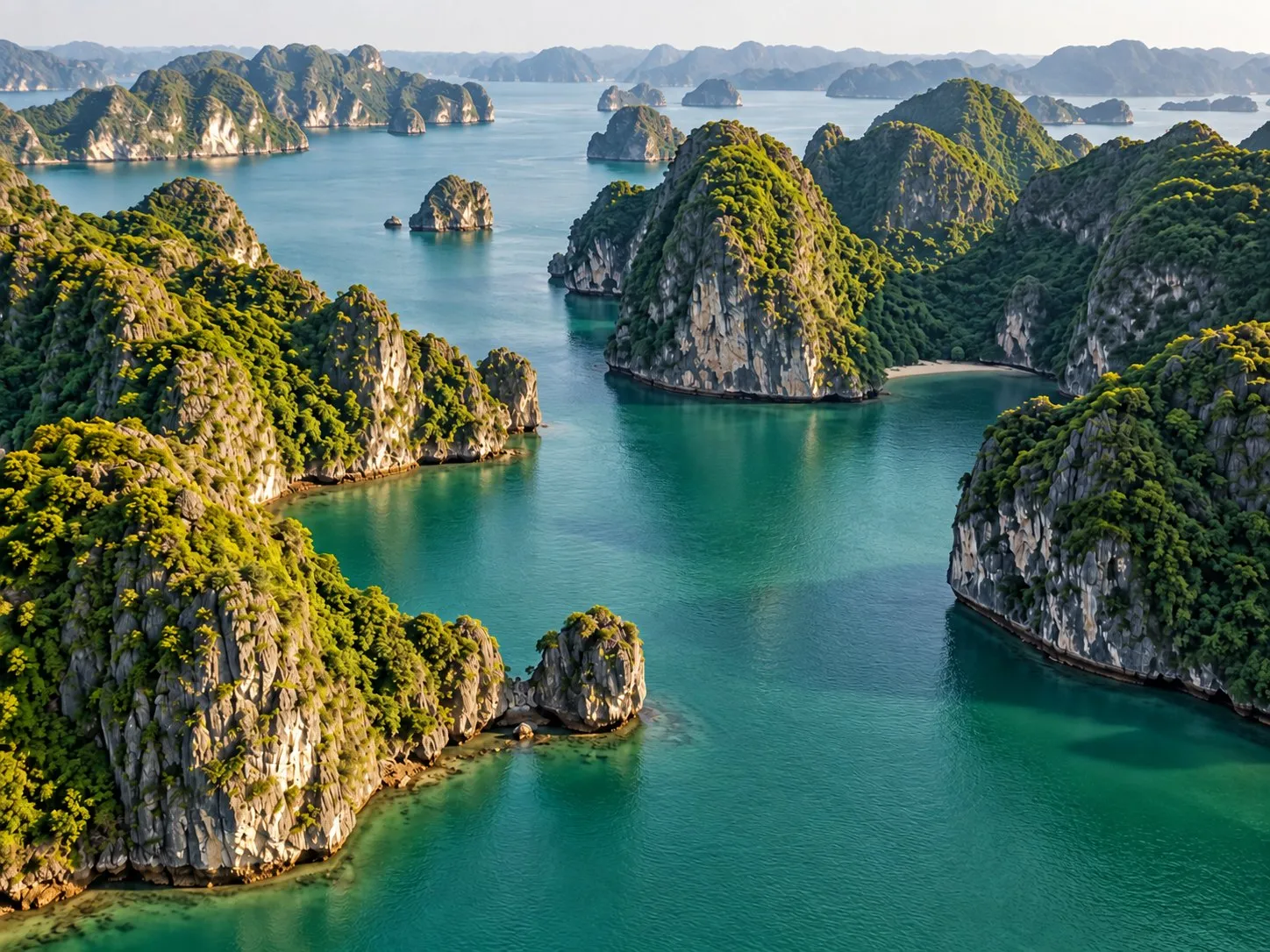
Less than most comparisons suggest. Both are limestone karst: towers and cones rising straight out of shallow green water, with channels and lagoons between them. If you have seen photos of one and liked them, you will like the other.
The difference is in the detail. Vietnam's national tourism authority notes how thickly Lan Ha's islands are covered in natural vegetation and counts more than 130 undeveloped beaches, some with caves.
Lan Ha has more small sandy coves tucked between the islands, while Ha Long is better known for its large caves and panoramic viewpoints. The scenery is beautiful in both, so we'd pay more attention to the itinerary than the photographs when deciding between them.

Which bay is quieter?
Lan Ha, generally. No official figures on daily boat numbers are published, so treat any precise count you read online with caution. What is clear is where Ha Long gets busy. Route 2, which the Ha Long Bay Management Department lists as taking in Ti Top Island, Sung Sot Cave, Luon Cave and Soi Sim beach, is the best-known circuit on the bay and the one most cruises follow.
That is not a reason to skip it. Sung Sot is a large, impressive cave, and the summit of Ti Top gives the view most people picture when they think of Ha Long. Go expecting company, and go early if you can.
Lan Ha has fewer famous landmarks and more small coves and lagoons scattered across the bay. That often makes for a more relaxed experience, particularly if you'd rather spend time on the water than move between busy sightseeing stops.
Which bay is better for kayaking, swimming and beaches?
Ha Long Bay: named sights close together
Ha Long's strength is how many well-known stops sit close together on the official routes. A typical one-night cruise kayaks or takes a bamboo boat through Luon Cave, then stops at Ti Top Island, where you can swim off the beach or climb to the summit. Route 3, the marine culture route, adds the Cua Van floating culture centre, Tien Ong Cave and Ba Ham lake.
You do get on the water in Ha Long, but that time is shared with caves, viewpoints and village visits. It suits people who like a varied programme with something new every couple of hours.
Lan Ha Bay: more time in the water
Lan Ha is the better pick if quiet coves and beaches are the point of the trip. State media count about 139 small sand beaches across the bay, and its lagoons are sheltered. Kayaking in Lan Ha Bay is temporarily suspended under local regulations (as of October 2026), so lagoons are visited by bamboo boat, with swimming where allowed. Fishing villages such as Viet Hai give you a reason to go ashore.
You can enjoy swimming in either bay during the warmer months, when conditions allow. But if you'd rather spend an afternoon among sheltered lagoons and beaches than visiting another cave, Lan Ha is likely to suit you better.

Which Bay Is Easier to Reach from Hanoi?
Not necessarily, especially when your cruise company arranges the journey. Green Ruby Cruises plans to use the same check-in point for both itineraries: the Green Ruby lounge at Tuan Chau, with check-in scheduled for around 10:45. Guests travelling to Ha Long Bay will transfer by tender to their ship, while those heading to Lan Ha Bay will travel by tender to Gia Luan Pier before boarding. Both itineraries currently list embarkation at 11:45.
From a Hanoi hotel the drive to Tuan Chau is about 2.5 hours, with pick-up at 08:00. Under the currently published arrangements, transfers can be requested separately and are not included in the cruise fare.
Travelling independently is a different story. Vietnam's tourism authority describes the public route to Lan Ha as a drive along the Hanoi–Hai Phong expressway to Got ferry wharf, a ferry across to Cat Ba, then a boat into the bay. It works, but it means more changes than a single drive to a Ha Long pier.
Does the weather differ between the bays?
No. The bays sit side by side and share the same regional climate: hot, humid summers and cooler, drier winters. October to April is the cooler and more popular season, with October and November, then March and April, usually the most comfortable. May to September is warm and good for swimming, but it is also storm season.
Storms and rough weather can lead local authorities to suspend cruises on either bay. If you're visiting during the summer months, it's worth checking the operator's cancellation policy before booking. Green Ruby's published policy outlines options that may include a full refund, rescheduling or an alternative service, depending on the circumstances and applicable booking terms.
In winter, evenings on deck get cool, so pack a warm layer. Weather is not a reason to choose one bay over the other.
Which Bay Should You Choose for a One-Night Cruise?
One night is where the Halong vs Lan Ha Bay cruise choice matters most, because there is no spare day to make up for it. Here are our two one-night itineraries side by side. They share the same check-in and boarding times, so the differences are easy to see.
The Halong Escape (Green Ruby 1) | The Lan Ha Escape (Green Ruby 2) | |
|---|---|---|
Check-in | Green Ruby lounge, Tuan Chau, around 10:45 | Green Ruby lounge, Tuan Chau, around 10:45 |
Boarding | Tender to the ship on Ha Long Bay, embarkation 11:45 | Tender to Gia Luan Pier, then board on Lan Ha Bay, embarkation 11:45 |
Day 1 afternoon | 15:30 Luon Cave by kayak or bamboo boat; 16:30 Ti Top Island, swim or climb | 15:30 Dark & Bright Cave area by bamboo boat (kayaking temporarily suspended) |
Evening | Dinner, cooking class and squid fishing | Dinner and evening programme |
Day 2 morning | 06:15 morning contemplation and breakfast; 08:00 Sung Sot Cave | 06:30 Tai Chi on the sundeck; 07:45 swimming at Ao Ech Lagoon, when conditions allow |
Return | 09:30 brunch as the ship returns to port | 09:30 check-out and brunch; disembark at Tuan Chau around 11:00 |
If you enjoy spending time on the water, we'd lean towards Lan Ha. The proposed itinerary includes a bamboo boat trip around the Dark & Bright Cave area on the first afternoon and a swim at Ao Ech Lagoon the following morning, when conditions allow. Kayaking in Lan Ha Bay is temporarily suspended under local regulations.
For a first visit to northern Vietnam, Ha Long has plenty to recommend it. Luon Cave, the views from Ti Top Island and Sung Sot Cave are all part of the classic experience, and the proposed one-night programme brings them together without requiring an extra day.
The full programme for Ha Long is on the Ha Long Bay 2 days 1 night itinerary page. For the quieter option, see the Lan Ha Bay 2 days 1 night itinerary.
Does a second night change the answer?
A second night gives you something a one-night cruise cannot: a full day to explore beyond the usual overnight stops. On both three-day itineraries, a day boat is scheduled to leave the main ship at 08:30 on the second morning, taking guests to places they would otherwise miss.
Ha Long Bay, 3 days 2 nights
The Halong Immersion uses its extra day for life on the water: Cua Van fishing village at 10:00, Tien Ong Cave, an archaeological site, at 11:30, lunch on the day boat, then a pearl farm at 14:00. Sung Sot Cave follows at 08:00 on the final morning.
Lan Ha Bay, 3 days 2 nights
The Lan Ha Immersion heads ashore instead: Viet Hai village at 10:00, explored on foot, by bike or by buggy, with lunch in the village, then a swim at a white-sand beach at 14:00. That evening the romantic dinner is set in a private space of your choice: your cabin, the sundeck, poolside or the function room. The last morning includes a cave visit at 08:00.
The extra day brings out a different side of each bay. In Ha Long, the focus is on fishing communities, caves and life on the water. In Lan Ha, there's more time ashore, with a village visit, cycling and a stop at the beach. For couples looking for a slower, more intimate trip, the Lan Ha itinerary may be especially appealing.
A second night also makes the drive easier to justify: around five hours of road time across the trip buys two evenings on the bay instead of one.
Which Bay Is Right for You?
New to Vietnam
Ha Long. Sung Sot, Ti Top and Luon Cave are the names that appear in most photos and guidebooks, and a one-night Ha Long route covers all three.
Couples
Lan Ha. Quieter anchorages, more beach time and, on the three-day route, a private dinner on the second evening.
Families with children
Both bays can be enjoyable for families. Younger children may prefer the small beaches of Lan Ha, while older children often find Ha Long's caves and the climb up Ti Top more exciting. In Ha Long, kayaking takes place in designated areas, subject to weather and safety conditions; in Lan Ha it is temporarily suspended. Life jackets and crew guidance are part of the planned activities, and children must be accompanied by an adult.
Travellers with limited mobility
Our ships have elevator access between guest decks, but every itinerary involves tender transfers, and shore stops can mean steps or uneven ground. On Ha Long, reaching the Ti Top summit is a climb and the caves involve steps. On the three-day Lan Ha route, Viet Hai can be explored by buggy. Talk through the details with the reservations team before you book.
Green Ruby 1 vs Green Ruby 2: What's the Difference?
With Green Ruby, each ship is dedicated to a different bay. Green Ruby 1 is planned for the classic routes of Ha Long Bay, while Green Ruby 2 will focus on the quieter waters of Lan Ha Bay. The two sister ships share the same design, so the main difference for guests will be the destination and itinerary rather than the onboard accommodation.
According to the current design specifications, each ship measures 121 metres in length, with four decks, 46 cabins and a maximum guest capacity of 136. Accommodation is divided into four categories: Imperial Suite (120 m²), Royal Romance Suite (80 m²), Ocean Breeze Premium (38 m²) and Serenity Deluxe (38 m²).
Both ships are designed with rooftop solar arrays of approximately 70 kW and seawater-cooled air-conditioning systems. These features form part of Green Ruby's energy-efficiency strategy. The projected energy savings of approximately 40% remain a design estimate rather than a verified operational result.
For company details and a plain summary of how the two ships compare, see Green Ruby's brand facts page. Both ships begin sailing in February 2027. Prices are not published yet, and the reservations team handles booking requests and quotes.

Frequently asked questions
Can I see both bays on one Green Ruby cruise?
No. Green Ruby 1 sails Ha Long Bay and Green Ruby 2 sails Lan Ha Bay, so each itinerary covers one bay in depth. If both matter to you, two separate cruises work better than rushing between them.
Are sightseeing entrance fees different on each bay?
Fees are set per route by the authorities, differ between routes and change over time, so check current figures before travelling independently. Green Ruby's published inclusions list all sightseeing entrance fees in the cruise fare.
Will I get seasick?
Rarely. Both bays are sheltered by thousands of limestone islands, so the water is usually calm. If you are sensitive to motion, bring a remedy as a precaution.
Can I fly into Hai Phong instead of Hanoi?
Yes. Cat Bi International Airport in Hai Phong is about 45 minutes to an hour from the port, and a transfer can be timed around your flight on request.
Is there phone signal on the bays?
Mobile coverage can be patchy among the karst islands on both bays. Both Green Ruby ships will have Starlink satellite internet on board.
If the Lan Ha Bay vs Halong Bay question is still open, start from two things: how many nights you have and the one thing you most want to do. Send both to the Green Ruby reservations team and they will suggest the itinerary that fits.