Planned Green Ruby stop
Where is Tien Ong Cave?
Tien Ong Cave is located on Cai Tai Islet, in the Hang Trai island group of Ha Long Bay, approximately 18 km from Tuan Chau International Marina.
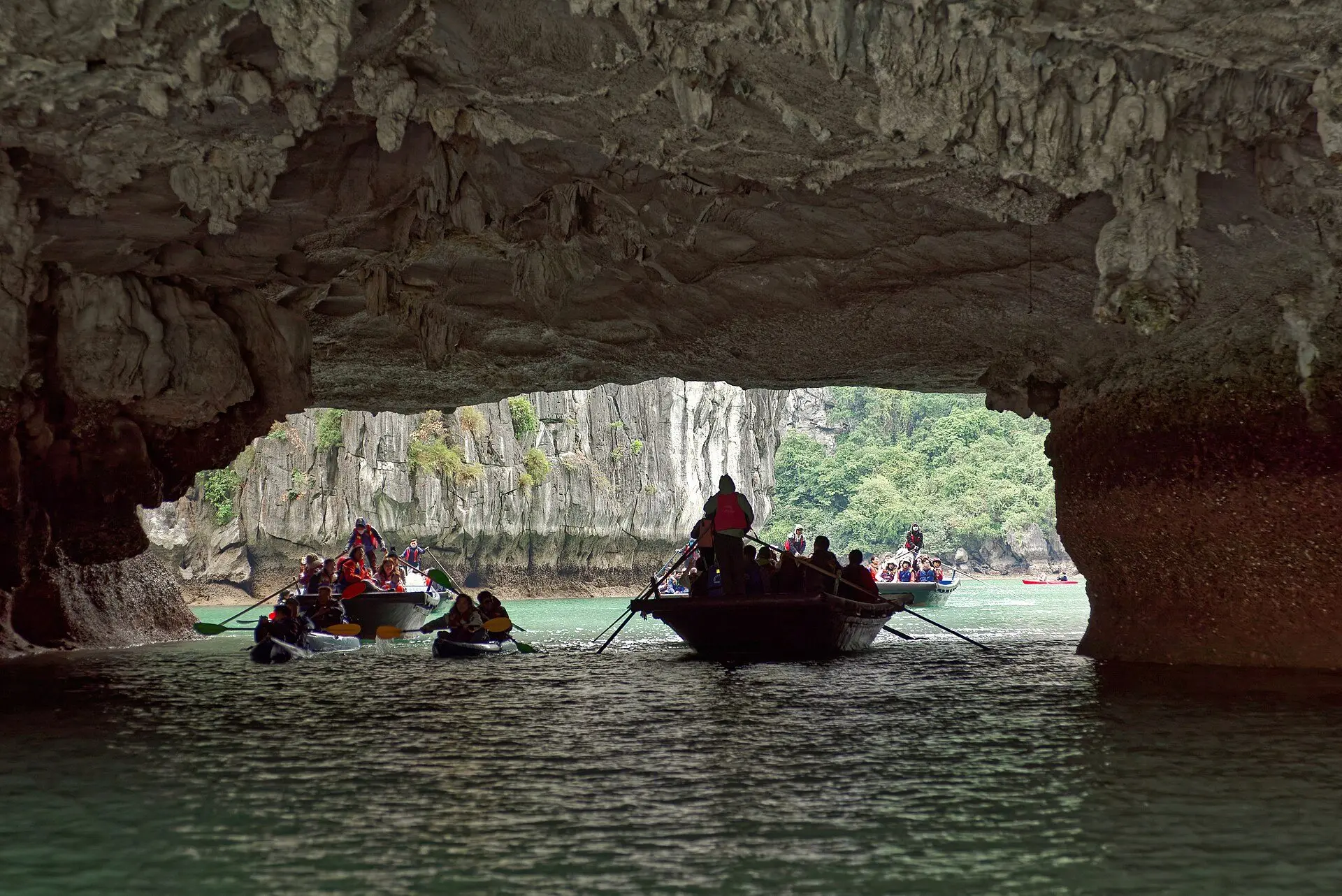
It lies near Cua Van Floating Village, and both sites are part of Ha Long Bay’s sightseeing Route 3. Cruises visiting this area often combine the cave with a boat tour around the former fishing village.
Tien Ong is farther from the main sightseeing stops around Sung Sot Cave, Luon Cave and Ti Top Island. It is therefore more commonly included in longer excursions and 3-day/2-night cruise itineraries.
The cave is also known locally as Hang Ren and was referred to as Hang Duc in early archaeological records.
What makes Tien Ong Cave special?
Tien Ong Cave is worth visiting for two reasons: its limestone formations and its archaeological history.
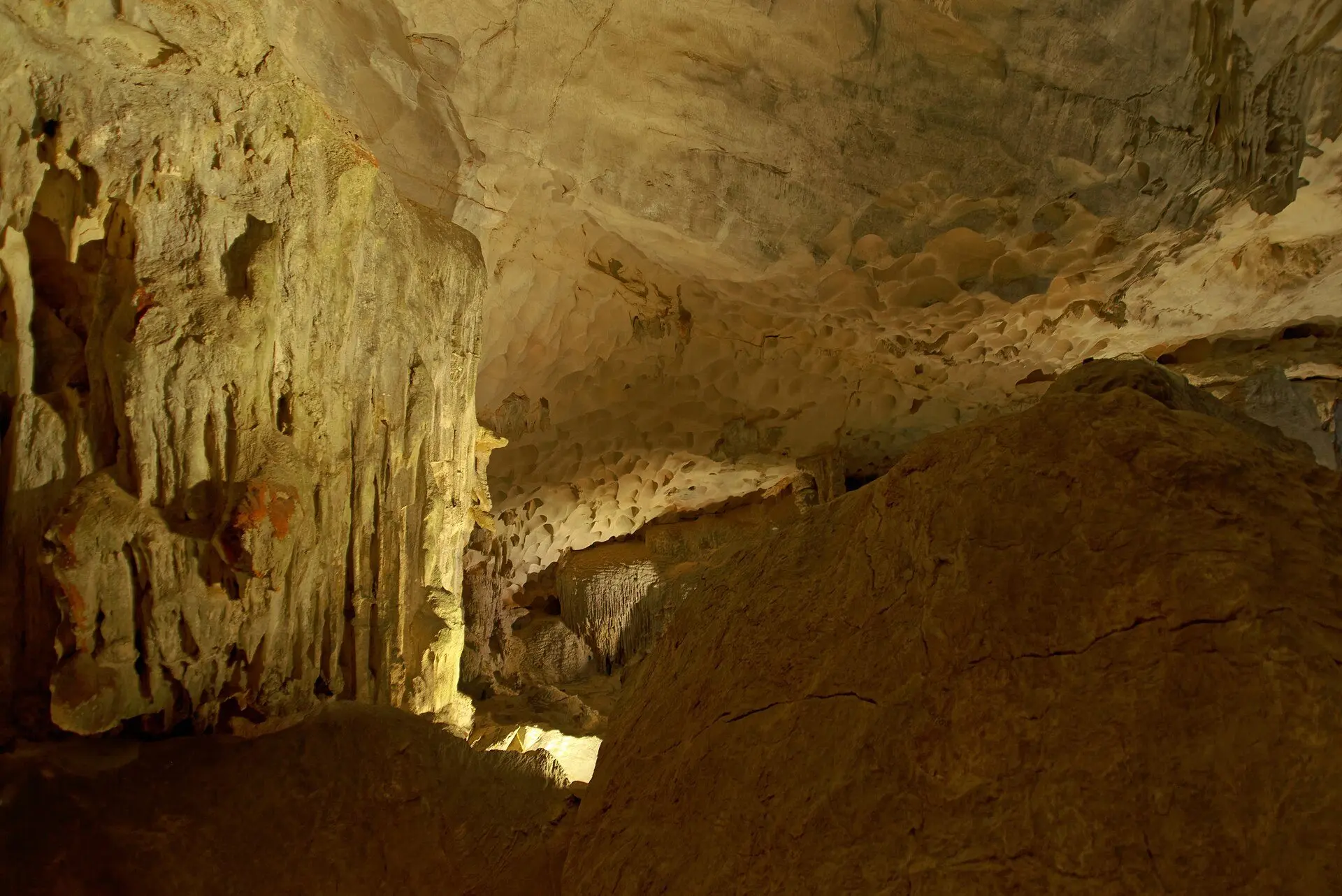
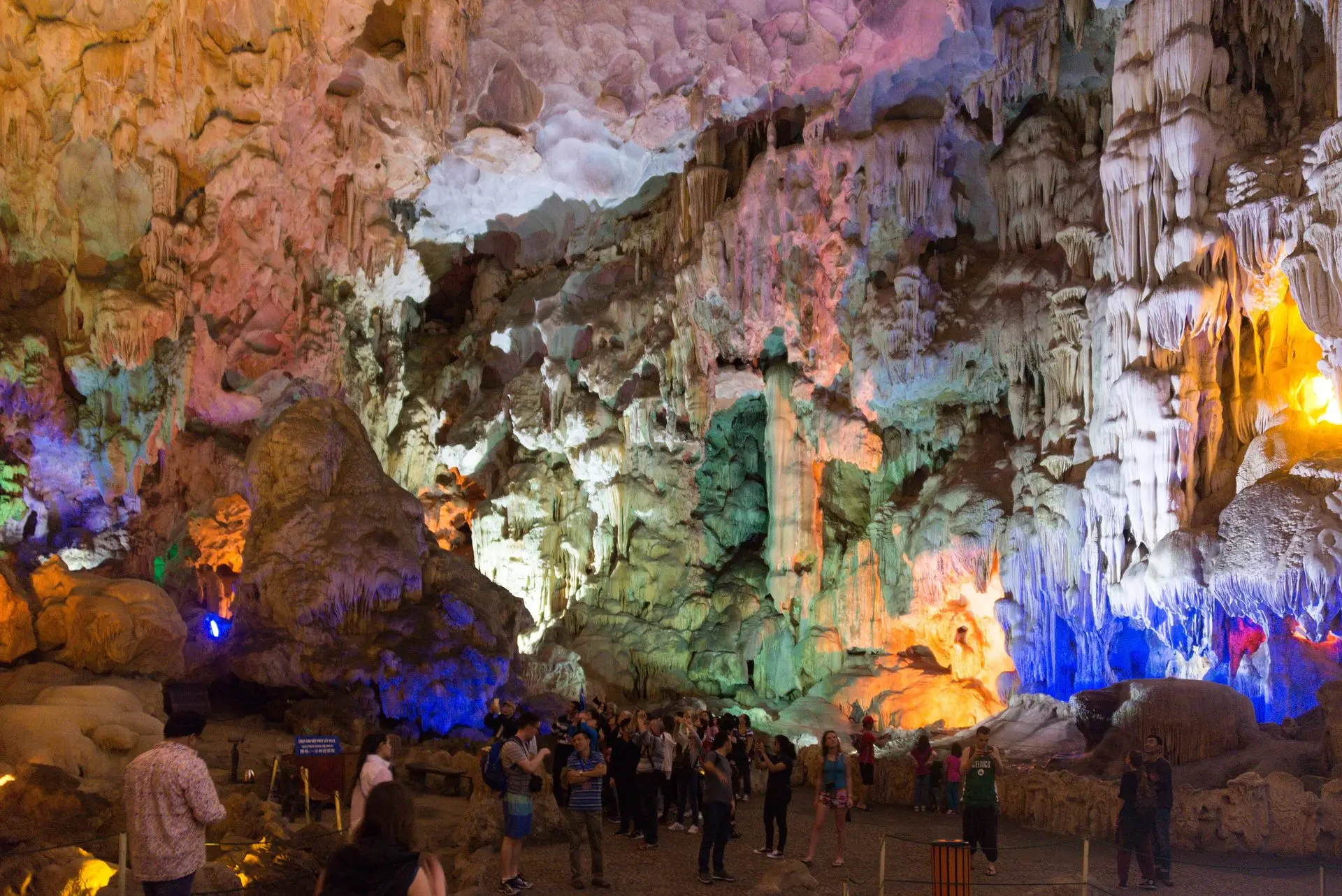
The cave has a broad entrance and a series of chambers and smaller recesses. Stalactites hang from the ceiling, while stalagmites rise from the cave floor. One formation resembles an elderly man with long hair and a beard, giving the cave its name.
In Vietnamese, Tien Ong refers to a legendary old sage or immortal. Local tradition associates the human-like rock formation with this figure.
But the cave’s most significant feature is found closer to the ground.
Archaeologists have uncovered evidence that prehistoric people lived here thousands of years ago. The discoveries include stone tools, animal bones and large deposits of shells left by people who used the cave.
Today, parts of this archaeological record are presented in an exhibition inside the cave, allowing visitors to see how the site connects Ha Long Bay’s landscape with its much older human history.
The prehistoric history of Tien Ong Cave
Tien Ong Cave is one of the important archaeological sites associated with the Soi Nhu culture in the Ha Long Bay region.
Archaeological research indicates that people occupied the cave approximately 8,000–10,000 years ago, during the transition from the late Pleistocene to the early Holocene.
These early inhabitants lived in a landscape very different from the Ha Long Bay we see today. Sea levels were lower, and areas now covered by water were once dry land.
The people who used the cave relied on resources available around them, including animals and freshwater molluscs. Archaeologists have found thick deposits of discarded shells, along with animal remains and stone and bone tools.
The findings suggest that the cave served as a place of human occupation rather than simply a temporary shelter.
In 2007, excavations by Vietnamese archaeologists helped establish the site’s age and significance. Earlier research had also been conducted here, including work by Swedish archaeologist J. G. Andersson in 1938.
These discoveries have helped researchers better understand prehistoric settlement and changing environments in what is now Ha Long Bay.
What can you see inside Tien Ong Cave?
Limestone formations and the old sage
The entrance to Tien Ong Cave is unusually wide, allowing natural light into its outer section.
Inside, the rock surfaces are marked by stalactites, stalagmites and smaller cavities formed over long periods as water moved through the limestone.
One stalagmite resembles the face and figure of an elderly man. This formation is the source of the cave’s present name.
The cave is illuminated for visitors, making it possible to examine the formations as you follow the designated walking route.
Archaeological remains
What distinguishes Tien Ong from many other sightseeing caves in Ha Long Bay is the evidence preserved in its floor deposits.
Excavations have revealed stone implements, bone tools, animal remains and layers of freshwater snail shells.
These objects tell us something about how prehistoric communities obtained food, made tools and adapted to their surroundings.
Rather than imagining the cave only as a natural attraction, visitors can see it as a place where people once spent part of their everyday lives.
The archaeological exhibition
In 2017, the Ha Long Bay Management Board worked with the Vietnam Institute of Archaeology and Quang Ninh Museum to establish an archaeological exhibition inside Tien Ong Cave.
The exhibition presents information and material connected with the site’s prehistoric occupation, helping visitors understand the discoveries made during archaeological investigations.
If you are particularly interested in history, allow time to read the displays rather than walking straight through the cave.
Exhibition access and individual displays may change, so follow the information available on the day of your visit.
How is Tien Ong Cave different from Sung Sot Cave?
Both caves are part of Ha Long Bay’s limestone landscape, but they offer quite different experiences.
Sung Sot Cave is known for its large chambers, elaborate rock formations and established walking route. It is one of the best-known stops on the bay’s main sightseeing circuit.
Tien Ong Cave is particularly interesting for its archaeological evidence. Its broad entrance, relatively accessible cave floor and on-site displays make it a place to learn about the people who lived in the region long before modern tourism.
Tien Ong is also on a different sightseeing route, so it generally receives visitors travelling farther into the bay.
If you are mainly interested in dramatic cave scenery, Sung Sot is likely to be the stronger choice. If you enjoy archaeology, early human history or less heavily visited parts of Ha Long Bay, Tien Ong offers something different.
How to get to Tien Ong Cave
Tien Ong Cave is accessible by boat as part of a Ha Long Bay sightseeing tour or cruise.
Most visitors travel from Tuan Chau International Marina or another authorised passenger port in the Ha Long area. See how to get from Hanoi to Halong Bay.
Because the cave is on sightseeing Route 3, it is not included in every day trip or overnight cruise.
Boats visiting the cave stop near the island, and passengers continue on foot from the landing area to the entrance.
The approach involves a short walk with some steps and uneven surfaces. Once inside, visitors follow the designated route through the accessible parts of the cave.
Green Ruby 1 includes Tien Ong Cave in its planned 3-day/2-night Ha Long Bay itinerary, alongside Cua Van Floating Village and a pearl farm visit.
How long does a visit to Tien Ong Cave take?
Allow approximately 30–45 minutes for a typical visit, including the walk from the landing area, time inside the cave and returning to the boat (estimate).
Visitors interested in the archaeological displays may wish to spend longer reading the information and looking at the exhibits.
The duration also depends on the tour schedule, walking pace and number of visitors.
For an organised cruise, check the time allocated by your guide before entering.
What to expect when you arrive
Tien Ong Cave has a wide entrance rather than the narrow opening found at some other caves around Ha Long Bay.
The floor lies only a few metres above sea level, so the approach is relatively short. There may still be steps, uneven surfaces and damp areas that require care.
Inside, visitors will find limestone formations and sections associated with the archaeological history of the cave.
It is generally less busy than Sung Sot Cave because fewer sightseeing itineraries travel along Route 3. However, visitor numbers vary, and the cave is not guaranteed to be quiet at every time of day.
Your guide may explain the local story behind the cave’s name and the archaeological discoveries made here.
Accessibility and practical tips
Tien Ong Cave is explored on foot and involves walking over surfaces that may be uneven or damp.
The route is not designed for wheelchair access, and visitors with limited mobility should ask their cruise operator about the approach and walking conditions before travelling.
A few things worth remembering:
- Wear shoes with good grip rather than slippery sandals.
- Watch your footing on steps and damp surfaces.
- Follow the designated walking route.
- Do not touch or damage stalactites, stalagmites or archaeological deposits.
- Avoid using flash where photography restrictions apply.
- Allow enough time to read the archaeological displays if history interests you.
The cave is a protected natural and archaeological site. Removing stones, shells or other material is not permitted.
Best time to visit Tien Ong Cave
Tien Ong Cave can be visited throughout the year when weather and cruise operations allow.
Because most of the visit takes place inside the cave, seasonal temperatures are less important than the conditions affecting boat travel across Ha Long Bay.
From April to October, the weather is generally warmer, but heavy rain, strong winds and tropical storms can disrupt cruises.
From November to March, conditions are usually cooler. Walking to the cave may be more comfortable, although damp weather can still make steps and pathways slippery.
Visits may be shortened, rescheduled or cancelled when authorities restrict boat movements for safety reasons. See the best time to visit Halong Bay for month-by-month conditions.
Explore Tien Ong Cave with Green Ruby Cruises
Tien Ong Cave is included in Green Ruby 1’s planned 3-day/2-night journey through Ha Long Bay.
The Halong Immersion – 3 Days 2 Nights
On the second day, guests transfer to a dedicated day boat to visit Cua Van Floating Village, Tien Ong Cave and a pearl cultivation facility.
The cave adds a historical perspective to the journey, showing that Ha Long Bay has been part of human life for thousands of years.
These are planned stops. Final timings and activities will be confirmed when Green Ruby’s sailings begin and may change due to weather, local regulations or operational conditions.
Nearby places and related experiences
Cua Van Floating Village
A former fishing village where families once lived in floating homes. Visitors can explore the sheltered cove by bamboo boat or kayak and learn about the area’s fishing heritage.
Sung Sot Cave
One of Ha Long Bay’s best-known caves, with large limestone chambers and an established walking route through Bo Hon Island.
Ti Top Island
A small island known for its crescent-shaped beach and hilltop viewpoint overlooking the limestone islands of Ha Long Bay.
Questions visitors ask
Where is Tien Ong Cave?
Tien Ong Cave is located on Cai Tai Islet in the Hang Trai island group of Ha Long Bay, approximately 18 km from Tuan Chau International Marina. It is part of sightseeing Route 3, near Cua Van Floating Village.
Why is it called Tien Ong Cave?
The name comes from a limestone formation that resembles an elderly man with long hair and a beard. Local tradition associates it with the image of a legendary old sage or immortal.
How old is Tien Ong Cave?
The limestone cave itself formed through geological processes over a much longer period. Archaeological evidence shows that people occupied the site approximately 8,000–10,000 years ago.
What archaeological discoveries were made at Tien Ong Cave?
Excavations uncovered stone tools, bone implements, animal remains and large deposits of mollusc shells. These findings help explain how prehistoric communities lived and obtained food in the Ha Long Bay region.
How is Tien Ong Cave different from Sung Sot Cave?
Sung Sot Cave is best known for its large chambers and spectacular limestone formations. Tien Ong Cave is especially significant for its prehistoric archaeological remains and on-site exhibition. The caves are also on different sightseeing routes.
Is Tien Ong Cave difficult to visit?
The walk is relatively short, but the approach and cave floor include uneven or potentially slippery surfaces. Visitors should wear suitable footwear. The site is not wheelchair-accessible.
How long does it take to explore Tien Ong Cave?
Allow approximately 30–45 minutes for a typical visit, depending on your walking pace and how much time you spend looking at the archaeological displays.
Is Tien Ong Cave included in a 2-day/1-night Ha Long Bay cruise?
Not in Green Ruby’s currently planned 2-day/1-night itinerary. Tien Ong Cave is included in the longer 3-day/2-night programme aboard Green Ruby 1.
When does Green Ruby plan to visit Tien Ong Cave?
Tien Ong Cave is scheduled for approximately 11:30 AM on the second day of Green Ruby 1’s planned 3-day/2-night itinerary. The visit remains subject to weather, local regulations and operational conditions.
Sources
- Ha Long Bay Management Department – Tien Ong Cave
- Ha Long Bay Management Department – Exploring the Archaeological Museum Inside Tien Ong Cave
- Vietnam National Museum of History – Archaeological Excavations at Tien Ong Cave
- UNESCO World Heritage Centre – Ha Long Bay–Cat Ba Archipelago
Information checked: