Planned Green Ruby stop
Where are the pearl farms in Ha Long Bay?
Pearl oysters are raised at marine farming sites in sheltered parts of Ha Long Bay. According to the Gemological Institute of America (GIA), Ha Long Bay is where most of Vietnam’s pearl farms are located, and most of their output is akoya pearls.
One well-known pearl-farming area is Tung Sau, a cove sheltered among limestone islands. Other farms operate elsewhere in the bay.
There is no single attraction called “Halong Bay Pearl Farm”. The farm you visit depends on the cruise or sightseeing programme. For Green Ruby guests, the pearl farm is a planned stop on the second day of the 3-day Ha Long Bay itinerary; the specific facility will be confirmed in the final itinerary.
Why visit a pearl farm?
Most visitors come to Ha Long Bay for its scenery. A pearl farm adds a look at work that takes place on the water.
Instead of exploring a cave or climbing to a viewpoint, you see how pearl oysters are cared for and why a cultured pearl takes time, skill and the right marine conditions. It also explains the difference between natural, cultured and imitation pearls, which is useful even if you have no plans to buy jewellery.
For travellers interested in local industries and life around the bay, it is a change of pace from sightseeing.
How are cultured pearls produced?
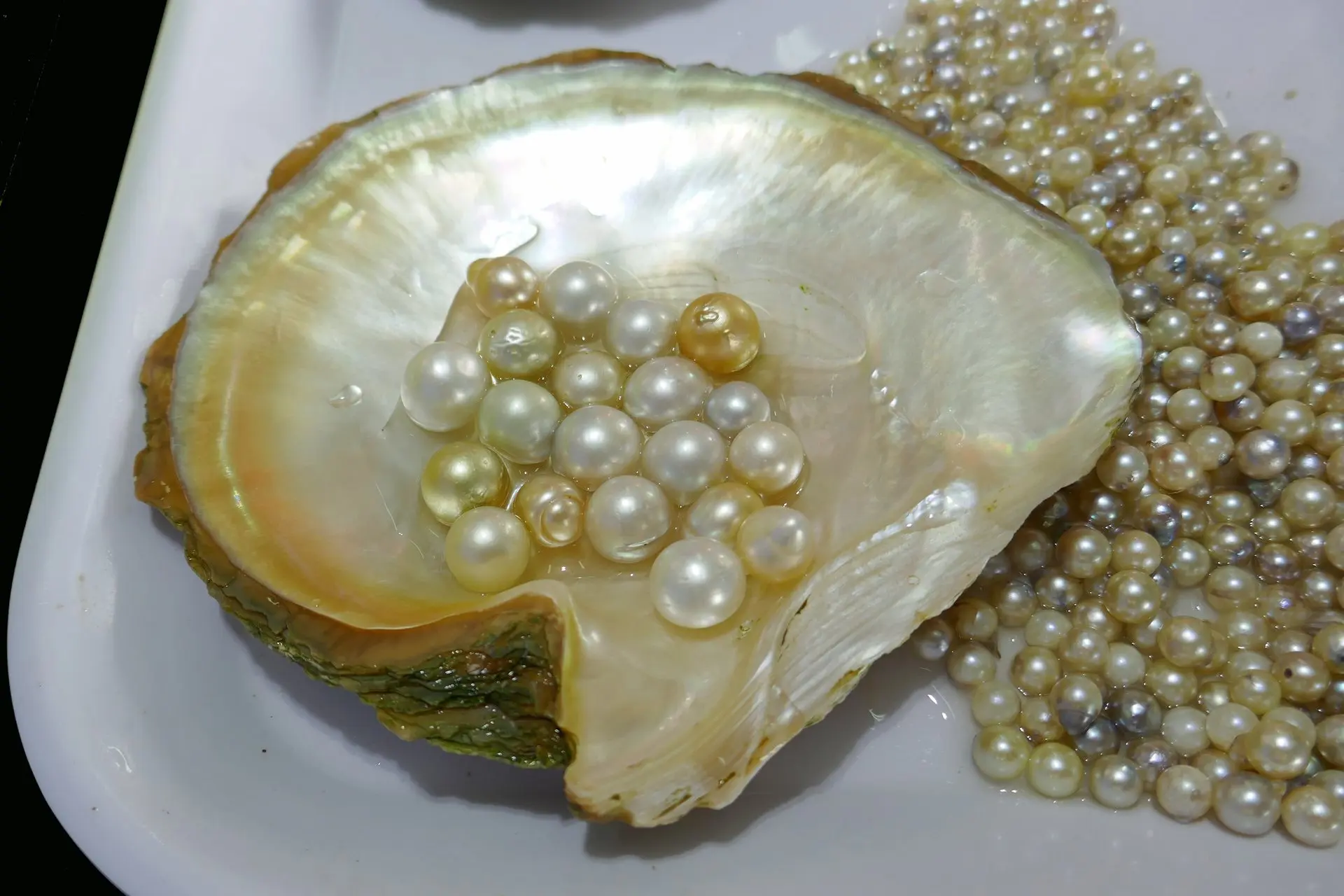
Cultured pearls are real pearls formed inside living molluscs, with human help to start the process.
1. Raising the oysters
Farms raise pearl oysters in seawater, where water quality, temperature and the health of the oysters all affect the result. Workers check and clean the oysters regularly.
2. Starting a pearl
For bead-nucleated pearls, a trained technician inserts a small shell bead together with a piece of mantle tissue from a donor oyster of the same species into a host oyster. The tissue forms a pearl sac around the bead, and the oyster secretes nacre (mother-of-pearl) onto it.
The exact technique depends on the oyster species and the type of pearl being grown.
3. Growing the pearls
Pearls do not form overnight. After the operation, the oysters are kept under observation before going back to the farm lines, where they lay down layer after layer of nacre. GIA researchers reported a formation period of about eight months for akoya pearls at one Vietnamese farm; other types of pearl need longer.
4. Harvesting and sorting
At harvest, pearls are graded by size, shape, colour, surface quality and lustre. Some are set individually; others are matched for earrings, bracelets or necklaces.
These steps describe pearl cultivation in general. What you see on a visit depends on the facility.
What to expect during a visit
A pearl farm visit is mainly an educational stop, and the programme varies. Depending on the facility, you may learn about:
- the oysters used for pearl cultivation;
- how they are cared for in the sea;
- how a cultured pearl is started and grown;
- how harvested pearls are assessed;
- finished pearl jewellery, where there is a showroom.
Some farms show the steps with demonstrations or displays; others give a guided introduction and a chance to see finished products. Do not assume you will see a live implantation or harvest unless the operator confirms it.
Natural, cultured and imitation pearls
Natural pearls form in molluscs without human intervention and are relatively rare.
Cultured pearls are also real pearls produced by a mollusc, but their formation is started by people, who then look after the molluscs while the pearls grow.
Imitation pearls are not pearls at all: they are made from other materials to look like pearls.
Can you buy pearls at the farm?
Some farms have a showroom with loose pearls and jewellery. Buying is your choice, not the purpose of the visit. If you are considering a purchase, ask:
- Are the pearls saltwater or freshwater?
- Where were they cultivated, and by which species of mollusc?
- Have the colour or surface been treated?
- Is there a receipt with clear product information?
- For higher-value pieces, is there an independent gemmological report?
Visiting a farm does not mean that every pearl on sale was grown there. For an expensive purchase, ask for documentation rather than relying on verbal assurances.
How do you get there and how long does it take?
Pearl farms in Ha Long Bay are reached by boat as part of a day tour or overnight cruise, not independently by road. Not every Ha Long Bay cruise calls at a pearl farm, so check that the visit is listed in your itinerary.
The length of the visit depends on the facility. On Green Ruby’s planned itinerary the visit starts at about 14:00 on Day 2; no separate duration is published. Most cruises start from Tuan Chau: see how to get from Hanoi to Halong Bay.
Practical tips
- Wear shoes with grip: landing areas and walkways near the water may be wet.
- Bring sun protection: parts of the visit may be outdoors.
- Ask before taking photos in working areas.
- Follow the guide: cultivation areas and equipment may be off limits.
- Check accessibility: boarding and floating platforms can be difficult for travellers with limited mobility.
Weather and visiting conditions
Pearl farm visits depend on the cruise programme and the weather. Rain or strong wind makes outdoor areas less comfortable, and during tropical storms the authorities may suspend boat movements in Ha Long Bay, so visits can be changed or cancelled. See the best time to visit Halong Bay for month-by-month conditions.
Visiting a pearl farm with Green Ruby Cruises
A pearl farm visit is part of the planned Day 2 programme of The Halong Immersion – 3 Days 2 Nights aboard Green Ruby 1.
| Time | Planned activity |
|---|---|
| 07:00 | Breakfast on board |
| 08:30 | Transfer to a dedicated day boat |
| 10:00 | Cua Van Fishing Village |
| 11:30 | Tien Ong Cave |
| 12:30 | Lunch on the day boat |
| 14:00 | Pearl farm visit |
| 15:30 | Return to the main ship and relax |
| 19:00 | Dinner and a second night on the bay |
The specific farm, demonstrations and visitor facilities will be confirmed as the itinerary is finalised.
Green Ruby 1 begins sailing in February 2027. All stops and times remain subject to the confirmed itinerary, weather and local regulations.
Nearby places and related experiences
Cua Van Floating Village
One of Ha Long Bay’s best-known former floating fishing villages. Its families moved ashore in 2014; a visit introduces the bay’s fishing heritage.
Tien Ong Cave
A limestone cave with evidence of prehistoric habitation and an archaeological display, visited on the same day.
Sung Sot Cave
One of Ha Long Bay’s most visited caves, on Bo Hon Island, with large chambers. On the same itinerary, on Day 3.
Questions visitors ask
Where is the pearl farm in Ha Long Bay?
Pearl farms operate in several sheltered parts of Ha Long Bay; Tung Sau is one known pearl-farming area. The exact farm depends on the operator and the itinerary.
How are pearls made at a pearl farm?
A technician implants a small shell bead and a piece of mantle tissue into a pearl oyster. Over the following months the oyster coats the bead with layers of nacre, which becomes the pearl.
Are cultured pearls real pearls?
Yes. Cultured pearls are produced by living molluscs. They differ from natural pearls only in that people start the process; imitation pearls, by contrast, are made from other materials.
Can visitors watch pearls being harvested?
Some farms have demonstrations or displays, but a live harvest is not guaranteed. Check what your programme includes.
Do you have to buy pearls during the visit?
No. The visit is an introduction to pearl farming; if there is a showroom, buying is up to you.
How long does a pearl farm visit take?
It depends on the facility. On Green Ruby’s planned itinerary the visit starts at about 14:00 on Day 2, and the day boat is back at the main ship around 15:30.
Do all Green Ruby cruises visit a pearl farm?
No. A pearl farm is currently listed only on The Halong Immersion – 3 Days 2 Nights aboard Green Ruby 1.
Which pearl farm will Green Ruby visit?
The specific farm is not named in the published itinerary. Its name and location will be confirmed before the programme starts.
Sources
- GIA Gems & Gemology (Fall 2020): Vietnam – Shell Nuclei, Pearl Hatcheries, and Pearl Farming
- GIA: Pearl description
- Industry and Trade Magazine (8 Nov 2023): Ha Long Pearl’s pearl farms at Tung Sau and Vong Vieng (Vietnamese)
- UNESCO World Heritage Centre: Ha Long Bay – Cat Ba Archipelago
- Photo: Pearl production in Halong Bay (29), Ji-Elle (Wikimedia Commons)
Photo: Ji-Elle, CC BY-SA 4.0, via Wikimedia Commons
Information checked: